Interviews - 19.09.2025
Kōrero with Bridget Douglas

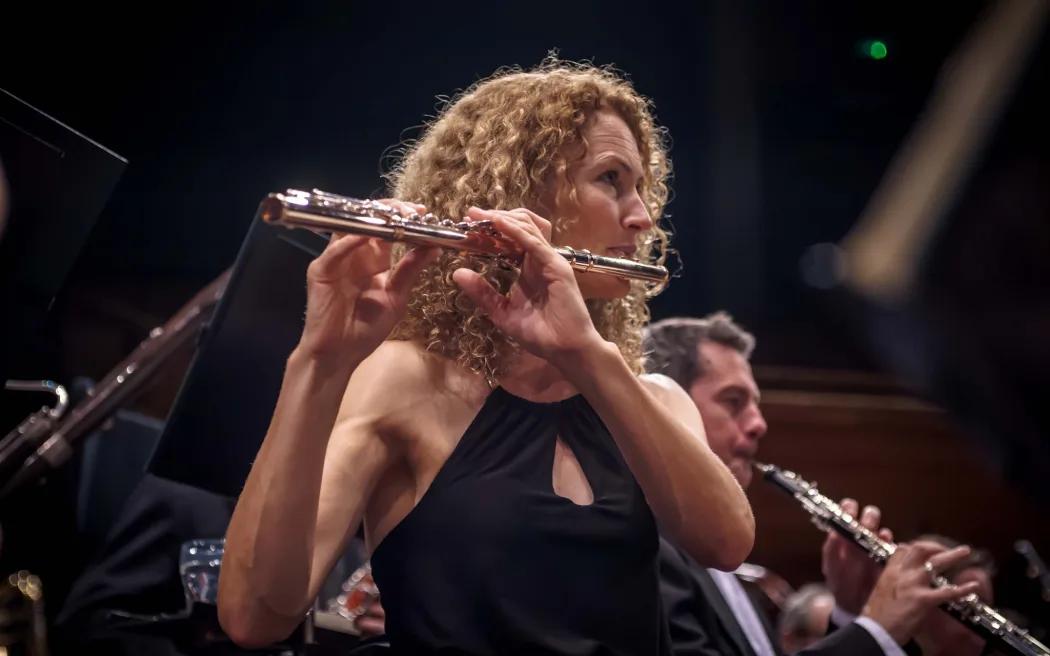
Check out our kōrero with Lamb & Hayward Masterworks: Holmes, Mozart, Tchaikovsky soloist and NZSO Section Principal Flute Bridget Douglas.
Have you performed Mozart’s Flute Concerto No. 2 before? If so, what’s it like returning to it? If not, what has stood out to you while preparing it for the first time?
I have performed Mozart's Flute Concerto No. 2 a couple of times with the NZSO – at our 75th Jubilee Concert in 2022 at the Michael Fowler Centre and again last year with the NZSO at the Grand Hall in Parliament. I also played it a great deal as a flute student with piano accompaniment as it's one of the pieces often required for orchestral auditions. As a flute teacher I am regularly teaching it to my students – it is a standard and much-loved work for all flute players (along with Mozart's other concerto for flute, in G Major). I never get sick of playing it as it epitomizes all that is great about Mozart – charming and elegant classicism, virtuosic solo lines and a fun interplay between soloist and orchestra.
Are there particular moments in this concerto that you especially enjoy playing or find particularly beautiful?
I think the central second slow movement, Adagio ma non troppo, is absolutely exquisite. It is so sensitive, intimate and personal. The gentle murmuring rhythms in the orchestral accompaniment are like a tender heartbeat, full of emotion supporting the delicate flute melody.
What are some of the technical or musical challenges in this piece, and how do you approach them?
Mozart's Flute Concerto No. 2 presents technical challenges for the flute player with its fast cross-fingerings, rapid leaps between registers and precise articulations – all while demonstrating a refined, even tone and excellent breath control. Musical challenges include expressing emotional depth within the seemingly simple structures and balancing technical brilliance with meaningful musicality. I approach these challenges with lots of very slow, thoughtful practice that gradually gets built up. I also record myself a lot. It can be quite painful listening back to myself but we can be our own best teachers!
Is there something about Mozart’s writing for the flute that feels particularly distinctive?
Mozart famously wrote in a letter to his father that he disliked the flute although most flute players and historians these days believe that Mozart only said this because he was having trouble fulfilling a commission for 'three short, simple flute concertos and a couple of flute quartets' and was complaining to his father because of the pressure he was under to deliver these works to a wealthy amateur flautist, Ferdinand Dejean. The Flute Concerto in D Major (written in 1778) is in fact a transposition by Mozart of his Oboe Concerto in C Major (written the year before for the Salzburg oboist Giuseppe Ferlendis).
Ultimately, I think all of Mozart's music is operatic in nature and needs to be 'sung' on whatever instrument you're playing. Mozart always wrote so beautifully for the flute in all his operas, symphonies, concerti and all his other chamber music. I believe he truly loved the simple vocal nature of the flute. All of Mozart's works are essentially chamber music – everybody is intimately connected by his music, both musicians and audience.
You’re performing this concerto with Christchurch Symphony Orchestra. What do you enjoy about stepping into the soloist role?
I am primarily an orchestral flute player, and I love being part of a much larger team that helps bring a piece of music to life. It is a treat to occasionally step into the soloist role at the front of the stage and have more ability to shape the overall work by being involved in decisions around tempo and phrasing. I really do think of this concerto as a great big chamber music piece though. We all have to listen and respond to each other on stage musically, what a joy!
Book tickets to Lamb & Hayward Masterworks: Holmes, Mozart, Tchaikovsky here. Saturday 27 September 2025, 7.30pm to 9.30pm, Christchurch Town Hall.